Content Is Not Marketing. It's Memory.
 Bret Siers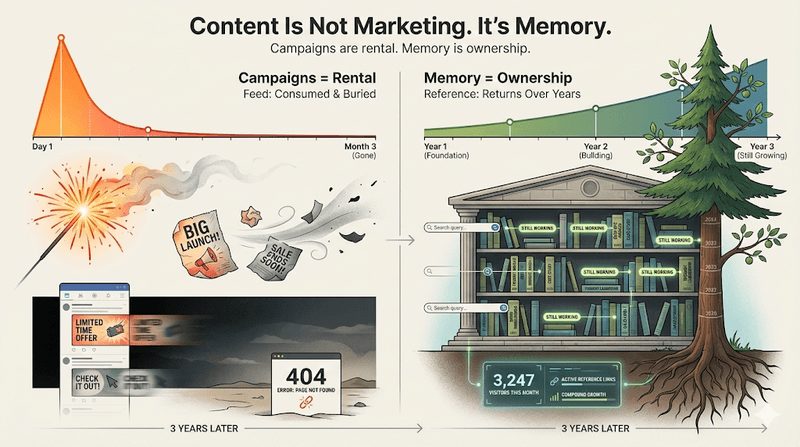
You're in your analytics dashboard looking for the spike from yesterday's announcement when you notice something you didn't expect.
A steady stream of visitors landing on an article you wrote three years ago.
You'd almost forgotten it existed.
It wasn't your best work. It wasn't part of a launch. You wrote it because someone kept asking the same question, so you answered it once, linked it to a few related pieces, and moved on.
Three years later, it's still working. Still answering. Still being found.
That isn't marketing.
That is memory.
We tend to treat the web like a feed. Something is consumed in the moment, then buried. But the data points to a different truth: the default state of the internet is not memory. It is decay.
One large study from the Filecoin Foundation, the Internet Archive, and Old Dominion University found the median lifespan of a web page is 2.3 years, and that about 60% of 27.3 million URLs analyzed were no longer accessible on the live web (source).
That means most of what gets published never survives long enough to become reference material. The pieces that do survive pass through a filter most people don't plan for.
They stay put.
And staying put turns writing into something discovery systems can learn from.
The Campaign Delusion
Founders rarely say "I'm building campaigns." They say "I'm publishing content." But the structure tells the truth.
Campaign-shaped writing is built for a moment. It assumes urgency. It leans on novelty. It often stands alone, because the point is the spike. It gets pushed, it gets a short burst of attention, then it collapses back into silence.
So you repeat.
This becomes a treadmill that looks like progress because it produces motion. But motion is not the same thing as accumulation.
The campaign delusion is the belief that visibility comes from repeated bursts. That discovery is something you buy or manufacture on demand. That your work "works" only when you are actively pushing it.
The problem is not effort. It's architecture.
Parking pages are not a pause state, they're a public state. Empty space becomes a durable signal. I wrote more on this here: Static Pages Don't Build Trust. Continuity Does.
What Discovery Systems Actually Remember
Let's make one key distinction that clears up most of the confusion.
Some queries are time-sensitive. People want "what happened today," "latest update," "current price," "this week's change." For those queries, freshness is the point.
Google explicitly describes "query deserves freshness" systems designed to show fresher results when a query expects recent information (source).
But most founder queries are not like that.
Most founder queries are closer to: What is this? Why does this happen? How does this work? What should I do instead?
Those are not "now" questions. They are "understanding" questions.
Discovery systems can learn from "understanding" pages because the underlying question repeats over years. But they can only learn if the page remains reachable in the same place, with the same meaning, long enough to become a stable reference.
The internet doesn't remember effort. It remembers what stays put long enough to be referenced.
Pew Research Center found that 25% of webpages collected from 2013 through 2023 were no longer accessible as of October 2023, and that 38% of webpages from 2013 were no longer accessible in 2023 (source).
The Difference Between Campaigns and Memory
If you want a simple test, look at the headline and the structure.
Campaign-shaped pages are about time. They anchor themselves to the moment. They are designed to be consumed once and replaced.
Memory-shaped pages are about utility. They answer a question that will be asked again. They are designed to be returned to.
The curve matters less than the reason the curve exists.
A campaign page tends to be "complete" at publish time. It doesn't need neighbors. It was built to travel, not to live.
A memory page becomes more complete as the constellation fills in around it. It links outward to neighboring concepts. It earns internal pathways that keep visitors moving through the library.
Articles still matter because they are one of the simplest formats for stable reference material. Related: Why Articles Still Matter in an AI World.
What This Means for Builders
If you are a founder, this is not a content strategy decision. It's an identity decision.
You can treat writing as a series of pushes meant to create short-term attention. If you do that, the work expires, and you stay on the treadmill. Each new push replaces the last.
Or you can treat writing as infrastructure.
Infrastructure is not glamorous. It is patient. It is designed to hold meaning over time, even as everything around it changes.
When you build infrastructure, you stop thinking in "updates" and start thinking in reference.
FAQs aren't "support content." They're the memory layer for recurring questions that block understanding. If you want the mechanics behind that idea, here's the deeper cut: The Role of FAQs in a Machine-Readable Web.
We've lived the loop: buy the domain in clarity, then renew it while the idea stays dark. Warming is choosing to make an idea legible before you feel ready. Quietly. On purpose. Discovery systems learn from repeated observation, and empty space becomes a durable signal. Warming turns ownership into presence early. What is SiteWarming?
The web forgets most of what gets published. That isn't a tragedy. It's just the physics of the medium.
The decision in front of you is whether your work is built to survive long enough to be remembered.
Campaigns are rental. Memory is ownership.
Share this article
Ready to Transform Your Domain Portfolio?
Start building real value with your domain investments today.