What Is SiteWarming? The Third State Between Parked and Built
 Bret Siers
SiteWarming
A service that turns a domain you already own into a live, indexed, continuously updated presence, without building a website. It occupies the third state between a parked domain (ad placeholder, no real content) and a built one (a full site you design and maintain). A warmed domain publishes genuine content on your name, so people, search engines and AI systems can find it and understand the idea behind it.
Not to be confused with domain warming in email marketing, which means gradually increasing send volume to build sender reputation with mailbox providers. Different problem, different category. More on that below.
In short: If you own a domain you haven't built, you have three options. Park it, and it earns someone else's ad revenue while sending no signal about your idea. Build it, and you owe it ongoing time you don't have. Warm it, and it becomes a small, real, indexed presence that grows on its own, so the idea stays discoverable while you decide what it becomes.
On this page
- What happens when an idea goes quiet
- What site warming actually is
- What a dark domain costs you
- How warming works
- Who this is for (and who it isn't)
- What changes when a domain goes from dark to warmed
- Frequently asked questions
You registered a domain. You had an idea behind it. A name that felt right, a future you could almost see. You told yourself you'd get to it.
That was a while ago.
Now it sits in your registrar, next to a few others just like it. Every year the renewal comes through and you pay it, because the idea still feels real. But the domain doesn't do anything. It doesn't go anywhere. It just sits there, parked, dark, waiting for a version of your life where you have time to build it.
Here's the thing. That's not your fault. That's the default.
What happens when an idea goes quiet
The internet gave us the ability to claim a name for an idea. Then it gave us exactly two options: build the whole thing or let it go dark.
Most people choose dark. Not on purpose. There's just no other path. Nobody designed that gap to be hostile, it ended up that way because the tools were built for people who were already moving, not for people who were still figuring out when.
How many domains are sitting unused?
More than you'd guess, and the number keeps climbing. As of June 30, 2026, there were 166.6 million .com domains registered, part of 401.6 million registrations across all top-level domains: up 8.1% year over year, according to Verisign's Domain Name Industry Brief.
A 2023 study by researchers at TU Munich found that more than 42 million domains were parked serving ads or placeholder pages with no real content. Millions more sit completely dark. Not because the people who own them are lazy. Because there's no middle ground between "fully built website" and "parked page with ads."
That's not edge behaviour. That's most of the internet.
I get it. You registered it because the idea was real. Maybe you were on vacation and the name came to you. Maybe you'd been thinking about it for months and finally pulled the trigger. The moment was honest. The intent was genuine. But life kept moving.
And then you do the arithmetic. One portfolio holder I spoke with was carrying 87 names at an average of $14.99, about $1,300 a year, every year, on ideas that had never left the registrar. Every invoice is a quiet reminder of the gap between what you believe in and what you've actually done about it.
Every time that renewal email hits, there's this quiet guilt. Am I actually going to do anything with this? You pay it because the answer is still "maybe." Because letting the domain go feels like admitting the idea was wrong. And it wasn't wrong. You just got busy.
That guilt is a signal. It means the idea still matters to you. But the system you're in, the one where the only options are "build it" or "abandon it", doesn't have room for ideas that matter but aren't ready yet.
Domain parking is not a neutral act. It's not a pause button. A parked domain isn't waiting for you; it's quietly losing ground. The ads on that parking page build someone else's revenue on your name. The absence of content tells every system that reads the internet that your idea doesn't exist. Every month it sits parked, the gap between your vision and your domain's reality gets a little wider.
What site warming actually is
So what's the alternative?
Not building a website. Not launching a product. Not writing anything yourself, hiring a designer, or learning to code.
Warming.
Warming is the act of making an idea visible, discoverable and growing on a domain you already own. It's a third state. Not parked. Not built. Warmed.
A warmed domain has context. It has a story. It has structured content that humans can read, search engines can index and AI systems can interpret. It isn't a finished product and it isn't a polished brand. It's enough presence that the systems reading the internet know you're there, know what your idea is about and can start connecting it to the people and conversations where it belongs.
Parked vs. warmed vs. built: the three states
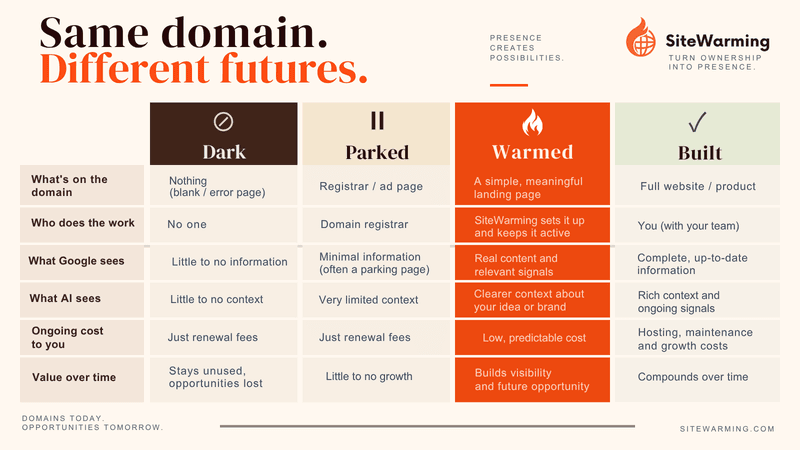
| Dark | Parked | Warmed | Built | |
|---|---|---|---|---|
| What's on the domain | Nothing | Ads or a placeholder | Real, structured content about the idea | A full website |
| Who does the work | Nobody | Your registrar | SiteWarming | You (or an agency) |
| What search engines see | Nothing to index | A thin page with no unique value | Indexable content on your name | A full site |
| What AI systems see | Nothing | Nothing usable | A readable, citable description of your idea | A full site |
| Ongoing effort from you | None | None | Minimal | Continuous |
| Who benefits from visitors | Nobody | The parking provider | You | You |
| Value over time | Flat | Flat, and borrowed against your name | Compounds | Compounds, if you keep it up |
Want the specific comparisons? We've broken down site warming against each of the major parking providers: GoDaddy, Spaceship, Atom, HugeDomains and nothing at all.
Is site warming the same as "domain warming" for email?
No, and the overlap in language causes real confusion, so it's worth being precise.
Domain warming is an email deliverability practice. When you start sending from a new domain, mailbox providers like Gmail and Outlook have no history for it, so you ramp your send volume gradually over several weeks to build sender reputation. It's about landing in the inbox instead of the spam folder.
Site warming is about discoverability. It gives a domain you own but haven't built a real, indexed web presence, so the idea behind the name can be found and understood by people, search engines and AI systems.
One is about whether your email arrives. The other is about whether your idea exists to the systems that decide what gets surfaced. They're different problems, and solving one doesn't solve the other.
What a dark domain costs you
So what does a parked domain actually cost? Not the renewal fee. The invisible cost.
There are three structural problems happening every day your domain sits dark.
| Signal lost | What's actually happening | Consequence when you finally build |
|---|---|---|
| Discovery | No crawlable content means no index presence and nothing for AI systems to retrieve | You launch into a cold start with no history behind the name |
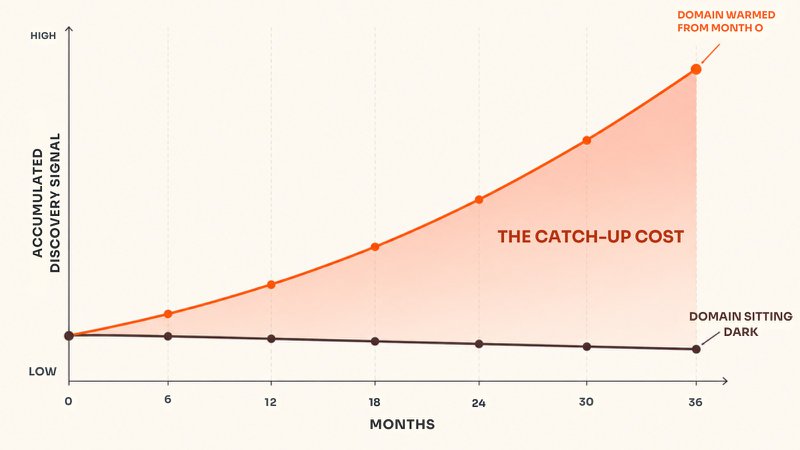
| Value creation | No content, links or engagement history accruing on the domain | Adjacent players have compounded; the catch-up cost rises every year |
| Brand completeness | No trust footprint attached to the name | Mail is treated with suspicion; the domain reads as unestablished |
Discovery: nobody can find it
Not people, not search engines, not AI systems. A parked domain produces zero signal. It's a name with no context, no story, no reason for anyone to pay attention.
If visibility determines whether an idea lives or dies, invisibility isn't sitting still, it's erosion. Someone could be searching for exactly what your idea solves, and they would never find you. Your idea is registered but undiscoverable.
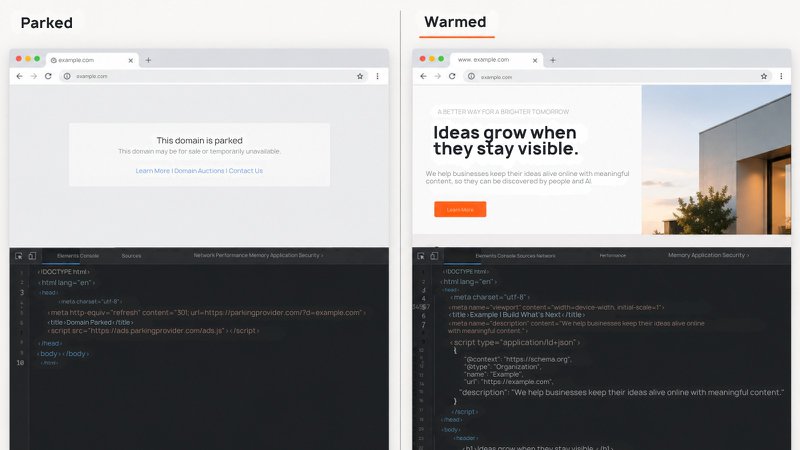
A typical parked page returns a redirect and an ad script, a few dozen bytes of non-unique content. A warmed page returns headings, body text and structured data describing the idea behind the domain.
Value creation: it doesn't hold steady, it slips
A domain that sits dark doesn't stay the same. It loses ground. Other people build in adjacent spaces. The conversations around your idea keep moving without you in them. The opportunity window shifts.
Meanwhile your domain accumulates nothing. No presence, no history, no proof that someone cares what this name represents. You're paying to hold it, but holding isn't growing. Value appreciation requires visibility, and visibility requires something to see. Every year a domain sits empty, the cost of catching up gets higher.
Brand completeness: the one most people miss
Your welcome email lands in spam. Your site gets flagged as untrustworthy by the systems that decide what people see. AI models skip your content entirely.
Here's what changed. When Google retired the Domain Reputation and IP Reputation dashboards from Postmaster Tools on September 30, 2025, it didn't stop judging your domain, it stopped showing you the score. Trust is now inferred from behaviour: authentication, complaint rate, engagement and whether there is anything real attached to the name at all.
A dark domain gives those systems nothing to work with. When you finally do build, you're starting from zero on a clock that's already been running.
These aren't abstract problems. Signals are the asset. Every day a domain sits dark, it isn't just missing opportunities, it's falling behind domains that are compounding. You can't see the discovery you're not getting. You can't measure the connections that never formed. But the damage is real.
Want the full arithmetic? We broke down the real cost of parking a domain across four cost categories.
How warming works
Warming isn't a metaphor. Something concrete happens to the domain. Here's the sequence.
You point the domain at SiteWarming and describe the idea in a sentence or two. From there, what the system publishes appears on your domain: how many pages, what kind of content. It updates [how often], and you can [what the owner can change]. You don't write it, design it or maintain it.
How long before a warmed domain shows up in search?
A parked page gives crawlers nothing to index, so it can sit unfound indefinitely. A warmed domain has content to crawl from day 1. Typically what you actually observe: first crawl in one or two months, index appearance after 6 months, etc. How fast that turns into discovery depends on the domain's history and how competitive the idea's language is.
Do I have to write anything myself?
No. That's the entire premise of the category. If you had the time to write and maintain a site, you would have built one already.
What happens when I'm ready to build the real thing?
Warming is a stage, not a destination. When you're ready to build, you're starting from a domain that already has content, history and index presence, instead of a cold start.
The mechanics in full: how SiteWarming works, step by step.
Who this is for (and who it isn't)
If you've ever registered a domain for an idea you weren't ready to build, this was made for you.
Maybe you've got twelve domains across four idea cycles. Maybe you're a creative person who registered a name three years ago and it still feels right. Maybe you're building something now and you've got three other names sitting in your registrar dashboard, waiting.
You're not lazy. You're not disorganised. You're someone with more vision than bandwidth, and you've been waiting for a system that understands that.
Most of the people who need this already know who they are. They're the ones who check their registrar once a quarter and feel something. Not excitement, not dread. Just that low hum of "I still believe in this, I just don't know when." The founder with a day job who registered the name for the thing they'll build when things calm down. The creative who's been paying twelve dollars a year to hold onto a feeling.
| Built for | Not built for |
|---|---|
| Founders holding names for ideas they'll build later | Domain flippers and traders |
| Creatives who registered a name that still feels right | Anyone looking for a marketplace or listing service |
| Anyone renewing domains out of conviction rather than plan | Anyone who wants a full website builder |
| Portfolio holders who want their names to mean something | People monetising domains before they've earned trust |
| People who'd rather the idea stay alive than go dark | People who see domains as lottery tickets |
If you're buying and selling domains as a trading strategy, that's a different game and a different set of tools. SiteWarming is built for people who see domains as promises they made to themselves.
It's a vision preservation system. The thing that keeps your idea alive while you figure out the rest.
Not sure which of your domains belong in which branch? Run your renewal list through the analyser.
What changes when a domain goes from dark to warmed
Your idea becomes visible. Not in some abstract, theoretical way. Visible to people who are searching for exactly the kind of thing you imagined. Visible to systems that decide what gets surfaced. Visible in a way that compounds, so that the longer the domain stays warmed, the more it's worth.
It has a presence. When someone looks you up, there's something real there. Not a pitch deck. Not a finished product. Something honest and alive that says: this is where this is going.
Warming is stewardship made visible. You already own the domain. You already believe in the idea. Warming is the act of letting that belief show up in a way the world can actually see.
And it matters more now than it did even a few years ago, because AI systems cannot read a parked domain. There's nothing there to read. No content, no signal, no context. Your idea is invisible not just to people browsing the internet, but to the models that increasingly decide what information gets surfaced and what gets ignored. A parked domain is a closed door to every system that could help your idea get found.
You don't have to build the whole thing. You don't have to know what the idea becomes. You just have to believe it's worth keeping alive. A warmed domain preserves your options. A dark one quietly removes them.
That's the shift. Not from parked to active. From dark to warmed. From invisible to discoverable. From guilt to growth.
Most ideas don't die because they were bad. They die because they were never made discoverable. Content is memory, and a warmed domain gives your idea the kind of memory that persists.
Frequently asked questions
What is site warming?
Site warming is the practice of turning a domain you own but haven't built into a live, indexed presence. Instead of a parked page with ads or nothing at all, the domain publishes real content about the idea behind the name so people, search engines and AI systems can find it and understand it.
How is site warming different from domain warming for email?
They solve different problems. Email domain warming means gradually increasing your send volume from a new domain so mailbox providers learn to trust it. Site warming means giving an unbuilt domain a visible, indexable presence on the web. One is about inbox placement; the other is about discoverability.
Is SiteWarming a website builder?
No. A website builder gives you tools and expects you to design, write and maintain a site. SiteWarming publishes and maintains a presence on your domain for you. You're not choosing a template or writing pages, you're keeping an idea visible while you decide what it becomes.
Do I have to write the content myself?
No. That's the point of the category. If you had the time to write and maintain a site, you'd have built one already.
How long before a warmed domain shows up in search?
Indexing timelines vary with domain history and crawl frequency, but a domain with real content has a path to discovery that a parked one simply doesn't have. A parked page gives crawlers nothing to index, so it can sit unfound indefinitely.
What happens if I decide to build the real site later?
Warming is designed to be a stage, not a destination. When you're ready to build, you're starting from a domain that already has content, history and index presence, rather than from a cold start.
Is this useful if I want to sell the domain instead?
Sometimes, though SiteWarming isn't built for flippers. A domain with real content and a discovery footprint reads differently to a buyer than a blank parking page. But if trading domains is your strategy, a marketplace is the better tool.
Isn't it cheaper to just keep paying the renewal?
The renewal fee is the visible cost. The invisible cost is everything the domain doesn't accumulate while it sits dark: no discovery, no history, no trust footprint and the fact that all of it has to be built from zero whenever you finally start. See what warming costs per domain.
Where to go next
- The complete guide to domain parking in 2026: how parking actually works, and what it does to your name
- The third option: why you don't have to choose between building and parking: the case for the middle path
- The real cost of parking a domain: the four cost categories the renewal fee doesn't show you
- Signals are the asset: why what your domain broadcasts matters more than what it's worth
- From ownership to stewardship: the shift in how to think about names you hold
- How SiteWarming works: the mechanics, step by step
You registered that domain because the idea mattered. It still does. And now there's a way to keep it alive without building the whole thing yourself.
You're not behind. You never were. You just needed a place built for exactly where you are.
Share this article
Ready to Transform Your Domain Portfolio?
Start building real value with your domain investments today.