Static Pages Don't Build Trust. Continuity Does.
 Bret Siers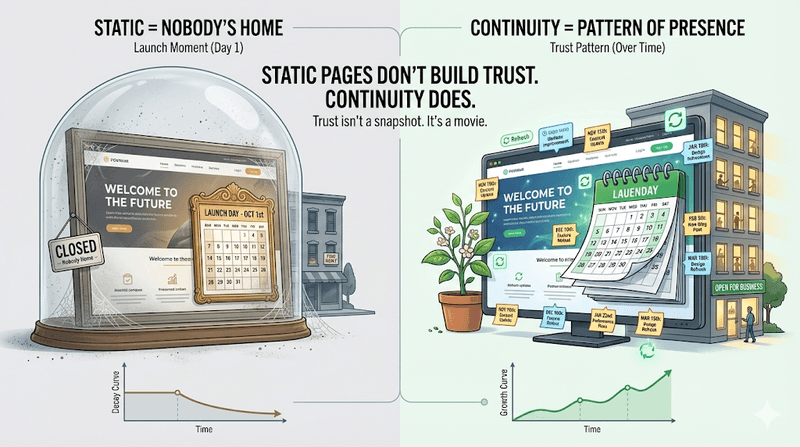
You spent three months on the launch. Every pixel polished. Every line debated. The site went live.
Then silence.
Six months later you check in and it feels the same: no meaningful discovery lift, no real sense of momentum, no clear signal that the site is doing its job. The "perfect launch" is already stale.
Here's the brutal truth about digital real estate: the launch wasn't the trust moment. Every day since was.
Trust isn't a snapshot. It's a movie. It's built on repeated observation.
When a potential customer, partner, or discovery system looks at a domain, they aren't only checking if it exists. They're checking if it's alive.
Static doesn't read as "finished." Static reads as "nobody's home."
There is data on the human side of this, and it's uncomfortable. Research finds that "no news is good news" doesn't apply to websites. Silence makes people wonder if the company is fading out. (Source: ProtoFuse)
Static perfection is fragility. Continuity is strength.
Launches are moments. Trust is a pattern.
Why launch moments don't build trust
Founders treat domains like buildings. You cut the ribbon, you move on, you assume the structure earns confidence by existing.
But the internet isn't a real estate registry. It's an information ecosystem, and information decays.
Nielsen Norman Group lays out four basic trustworthiness cues: design quality, upfront disclosure, comprehensive and current content, and connection to the rest of the web. (Source: NN/g)
That phrase "current content" matters more than people want it to.
It doesn't mean you need to publish constantly. It means the site has to show signs of stewardship. A maintained site signals an operator behind the wheel. An unchanged site signals uncertainty.
Verification is the new trust mechanic, and it only works when it's repeated. Verification isn't a badge. It's ongoing proof. I wrote more on this here: verification requires ongoing demonstration.
The site that shipped imperfectly, then left a small, dated footprint every month for a year, usually earns more confidence than the perfect site that went silent. Not because it's louder. Because it's observable.
What discovery systems actually look for
A lot of founders translate this into a single anxious query: "SEO."
Here's the cleaner frame: visibility systems prefer what stays legible.
Google documents "query deserves freshness" systems designed to show newer content when people would expect it. Google explicitly cites examples like recent movie reviews or news after an earthquake, moments where old data is wrong data. (Source: Google Search Central)
Two important things drop out of that.
First, freshness is not a universal rule. Some topics are stable, and a well-made page can hold its value.
Second, freshness is absolutely real when the world is changing.
Search Engine Land describes QDF as prioritizing newer content when a topic is trending, rapidly evolving, or changing over time. (Source: Search Engine Land)
So the goal isn't "post more." The goal is to avoid training systems to treat your domain as a dead end.
Continuity signals that count
Let's get practical. What counts as "ongoing presence" if your product doesn't change every week?
Continuity is not volume. Continuity is proof of stewardship.
A few signals that work even for quiet products:
- A public changelog, updated monthly or quarterly
- A "What's new" note with a date and one honest sentence
- A refreshed explanation on a core page because you learned a better way to say it
- Retiring outdated claims instead of letting them rot
- A visible "Published" and "Last updated" line on pages where accuracy matters
How small updates compound into credibility
This is the part most founders miss: continuity has compounding behavior.
Not because the updates are magical, but because repeated observation creates a durable signal.
Google's core updates documentation includes a line that makes the time dimension explicit. Core updates are designed to present helpful and reliable results, and "as content on the web changes," Google assesses and updates its systems to keep pace. (Source: Google)
The web changes whether you participate or not.
A maintained domain is stronger when the wider web echoes that you're real. Related: social proof multiplies continuity.
The operator's advantage: systems over intensity
Operators don't win by hustling daily. They win by building a cadence they can actually sustain.
Here's a cadence that doesn't turn into a second job:
Monthly (15–30 minutes): One small, visible touch. Fix something. Clarify something. Add one dated line that reflects reality.
Quarterly (60–90 minutes): A short "state of" note. What changed, what didn't, what you're paying attention to. Dated. Honest. Small.
Annually (half day): A real sweep. Remove stale claims. Update screenshots. Refresh the definitions that became unclear.
Scale forces stewardship to become a system. Related: scale requires systems.
And this is the bridge forward: continuity becomes memory. The record builds over time, and the internet's signal layer learns who is still here.
Continuity isn't just presence. It's how the internet remembers. If you want the mechanics behind that idea, here's the deeper cut: continuity becomes memory.
We've lived the loop: buy the domain in clarity, then renew it while the idea stays dark. Warming is choosing to make an idea legible before you feel ready. Quietly. On purpose. Discovery systems learn from repeated observation, and empty space becomes a durable signal. Warming turns ownership into presence early. What is SiteWarming?
Launches are moments. Trust is a pattern.
Share this article
Ready to Transform Your Domain Portfolio?
Start building real value with your domain investments today.