Domain Authority vs Domain Quantity: What Actually Matters
 Bret Siers
You check your analytics. Fifty-three visitors last week.
Your stomach sinks. It feels like nobody saw you.
Then you notice a competitor or a viral outlier with 50,000 visitors a month and think, that must be the difference.
But you are both staring at the wrong number.
Across fourteen industries, Ruler Analytics reports an average website conversion rate of 3.3%. That's fewer than 25 meaningful actions per 1,000 arrivals.
So if you have 50,000 visitors and they're the wrong visitors, you didn't build value. You built a loud room full of people looking for the exit.
I'd rather have 200 visitors who are actually looking for what I built.
Because domain value doesn't form from spikes. It forms from durable signals of quality. Visibility is not how many people pass by you. It's who recognizes you.
What visitor counts actually measure
High visitor counts feel like proof. Low ones feel like invisibility.
That reaction is normal. It's also misleading.
Visitor volume measures attention. Attention is easy to rent and easy to lose. It shows up in bursts, and it often says more about distribution than it says about trust.
Trust behaves differently. Trust turns a small domain into a known place for a specific idea. It makes people return. It makes them reference you without hedging. It makes systems treat you as stable instead of noisy.
Google's Danny Sullivan has been unusually direct about a common misunderstanding: E-E-A-T isn't a lever you pull. Declaring someone an "expert" doesn't magically change how systems treat a page, because anyone can self-declare and systems aren't validating credentials the way people imagine.
You can buy attention. You can manufacture a spike. You cannot manufacture recognition.
Parking pages aren't a pause state. They're a public state. If you want the mechanics behind that idea, here's the deeper cut: "I'll Build It Later" Is the Most Expensive Plan.
Why the systems care about signals, not scale
The shorthand people reach for is E-E-A-T: Experience, Expertise, Authoritativeness, and Trust.
It reads like jargon until you translate it into human logic:
- Experience: have you actually been close to what you're describing?
- Expertise: do you understand it well enough to be useful?
- Authoritativeness: do other credible places treat you as real?
- Trust: does this hold up when someone depends on it?
Google's documentation makes a distinction that matters: E-E-A-T itself "isn't a specific ranking factor," but a mix of signals that align with strong E-E-A-T is useful. The point is not to "have E-E-A-T." The point is to be legible as high-quality when observed.
Then Google names the center of the whole idea: trust is most important.
That's the hinge.
If trust is central, then volume cannot be the foundation. Volume can be a byproduct later, but it cannot do the job of trust early. A domain with 200 visitors and clean trust signals can be "healthier" than a domain with 20,000 visitors and shallow engagement.
Not because small is virtuous. Because signals are how systems interpret reality.
Discovery systems behave like memory. They learn from repeated observation. They store what they can reliably interpret. Empty space becomes a pattern. Noisy space becomes a pattern too.
What you want is legible space.
Trust is the asset. Visitor volume is the noise the asset makes when it's working.
The quality signals that actually compound
If volume is vanity, what compounds instead?
Signals that are stable enough to be remembered.
Here are four, stated without tool language:
1) Being cite-able
Can someone reference you without apologizing? Is your idea stated clearly enough that it can be repeated accurately? When the topic matters, do you show your basis?
2) Consistent proof of life
Not constant publishing. A pulse. A clear center. A domain that doesn't feel abandoned the moment someone arrives.
3) Depth that reduces doubt
Depth isn't length. Depth is when a reader stops hunting for a better explanation because yours finally made the thing make sense.
4) Structure that improves legibility
Headings that match real questions. Pages that mean one thing. Language that stays consistent over time. This isn't aesthetics. It's interpretability.
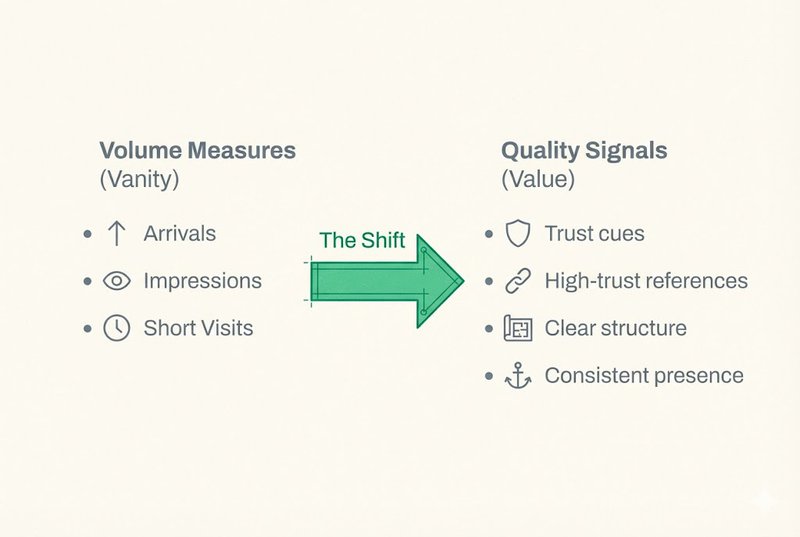
A useful proxy for this shows up in other ecosystems. Micro-influencers under 10,000 followers are often cited as generating materially higher engagement than large accounts, in some cases around 60% higher. The mechanism isn't "small is better." The mechanism is alignment. Smaller, aligned audiences produce clearer signals than larger, indifferent ones.
When you chase volume, you get a leaky bucket audience. When you build signals, you get a reservoir. People return. People reference. Systems learn.
And if you want a reality check that keeps you honest, keep the 3.3% statistic nearby. Most arrivals do nothing meaningful on average. Your job is not to inflate arrivals. Your job is to increase the share of arrivals that are aligned.
Why a small, right audience beats a large, wrong one
Kevin Kelly's "1,000 True Fans" has survived because it's not a creator fantasy. It's a durability model.
The number isn't the point. Alignment is the point.
A small group of people who care deeply can sustain serious work. They return. They pay attention. They tell the right other people. They become the internet's memory for your idea.
In domain terms, a domain known for one specific thing, serving one specific audience exceptionally well, becomes an authority in the only sense that matters. It becomes a remembered node in the network.
A domain built for viral attention is fragile. It might spike. It might even feel "successful." Fragility shows up later as churn: lots of arrivals, no memory.
This matters even more now that AI systems sit inside discovery. I'm not claiming they have one preference you can cater to. I am claiming something simpler: systems are easier to move with clarity than with noise. They can't "trust" what they can't interpret.
Structure and specificity sharpen the signal. Volume often blurs it.
You're speaking to humans and systems at the same time now. Related: The Internet Now Has Two Audiences.
We've lived the loop: buy the domain in clarity, then renew it while the idea stays dark. Warming is choosing to make an idea legible before you feel ready. Quietly. On purpose. Discovery systems learn from repeated observation, and empty space becomes a durable signal. Warming turns ownership into presence early. What is SiteWarming?
What this means for your domains
Stop apologizing for low visitor counts.
If you're building something real, the numbers should be low early. That's not failure. That's filtering. It means you haven't blurred the message to appeal to everyone.
Then shift what you're trying to build. Don't design for "views." Design for recognition.
Ask questions that force signal clarity:
- Does this domain communicate, in one screen, what it is and who it's for?
- If someone arrives cold, do they understand the shape of the idea?
- If someone is deciding whether to trust this, do you give them reasons they can verify?
- If someone wants to reference you, did you make that easy?
Next, earn a few real connections. Not the old obsession with quantity. Not spraying links. I mean references that make sense in the world, from places that already hold trust. When they point at you, they're not "helping your numbers." They're lending interpretability.
And if you're holding multiple domains, this changes everything. You stop trying to turn every domain into a media property. You start treating each as an idea that needs a clear, trusted footprint.
A collection of domains becomes a collection of signals. This shows up in a different form here: Accidental Aggregators.
You might feel like a failure when a thoughtful update gets 200 reads instead of 20,000.
But those 200 might include the decision-makers, investors, or collaborators you actually need. The other 19,800 were just passing through.
The next time you check your analytics, don't count visitors first.
Ask: who came, did they stay, did they return, did they trust what they found enough to reference it?
Those are the signals.
Everything else is vanity.
Share this article
Ready to Transform Your Domain Portfolio?
Start building real value with your domain investments today.