Structured Content for Machines
 Bret Siers
I published a piece on one of my domains last year. Spent real time on it. Wrote something I was genuinely proud of, put it on a domain I'd been accelerating for months. Then I asked ChatGPT a question my article directly answered.
My domain didn't appear. Not in the answer. Not in the citations. Not anywhere.
The content existed. It was indexed. But the AI system pulled from three other sources that said essentially the same thing, with less depth. What they had that I didn't wasn't better writing. It was JSON-LD schema markup declaring what the content was, who wrote it, what entities it referenced.
That gap between "exists" and "gets cited" sat with me for days. I kept going back to it. Not because I was frustrated about the visibility. Because I realized the problem wasn't my writing. It was that I'd never introduced my writing to the machines reading it.
A BrightEdge study, from a company that provides structured data tools, tracked millions of AI-generated responses and found that 82.5% of citations in Google AI Overviews come from pages with structured data. Pages with comprehensive schema markup are three times more likely to appear. Sites implementing structured data and FAQ blocks saw a 44% increase in AI citations.
The other 17.5%? That's not a strategy. It's a lottery ticket.
What Structured Content Actually Is
The phrase "structured content" gets thrown around loosely, so let me define it precisely. This article is where the definition lives.
Structured content is content that carries machine-readable descriptions of what it is, who created it, and what entities it represents. It enables discovery systems, AI models, and evaluation systems to parse, cite, and verify it without human interpretation.
It's not a separate layer from the content humans read. It's the same content, translated into a vocabulary machines understand.
That vocabulary has a name: Schema.org. Founded in 2011 by Google, Microsoft, Yahoo, and Yandex. Not one company's proprietary format. A shared language, agreed upon by competing search engines, for describing what things are.
The scale tells the story. Schema.org now encompasses 827 types, 1,528 properties, 14 datatypes, 94 enumerations, and 522 enumeration members. That's not a markup trick. That's a taxonomy for describing reality in terms machines can interpret.
The implementation format that matters is JSON-LD: JavaScript Object Notation for Linked Data. It sits alongside your HTML in a script block, describing the page's content in machine-readable terms without modifying the visible page at all. Google explicitly recommends JSON-LD as the easiest format to implement and maintain. And it dominates. 83.2% of all schema implementations use JSON-LD.
For domain owners, the schema types that matter most are straightforward:
- Organization: who you are, what you do, where your verified presence lives
- Article: what you published, who wrote it, when, about what topic
- FAQPage: what questions your content answers
- Person: who is behind this domain
- WebSite: what this domain is as a navigable entity
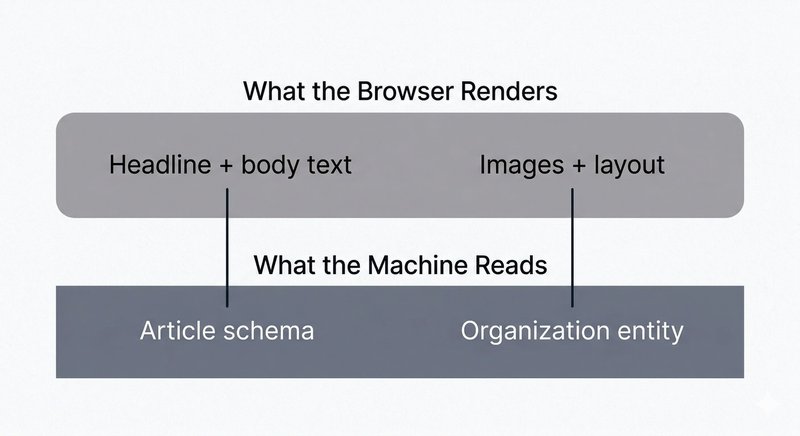
These don't change how your page looks to a human visitor. They create a machine-readable identity layer. Not a visual layer. An interpretive one. The machine no longer has to guess what your page is. You told it directly.
Without them, your content exists but can't introduce itself.
The Machine Reads Structure, Not Style
When a human visits your page, they see design. Layout. Typography. Images. They infer meaning from visual hierarchy. The big text at the top is the title, the photo is of the founder, the bulleted list is a set of services. Understanding is automatic.
A machine sees none of this. A machine sees HTML. And most HTML describes how things look, not what things are. A <div> with class="hero-section" tells a machine nothing about the entity it represents. A beautifully formatted FAQ section, without FAQPage schema markup, is just paragraphs with question marks in them.
Here's why that gap went from inconvenient to urgent.
According to Cloudflare's 2025 Year in Review, AI bot crawling accounted for an average of 4.2% of all HTML requests throughout 2025, nearly matching Googlebot's 4.5% share. Individual training crawlers like GPTBot and ClaudeBot, at their peak request volumes, reached seven to eight times the volume of individual traditional search crawlers. And user-action AI crawling, bots that fetch your page in real time when someone asks an AI assistant a question, surged more than fifteen times year-over-year.
That last number is the one worth sitting with. There is a class of reader that visits your domain not because a person clicked a link, but because someone asked an AI system a question and the system came to your page looking for the answer. When it arrives, it isn't reading your page the way you read it.
These systems are extracting signal. If your content has no structured data, the machine must infer everything from raw text. If your content has structured data, the machine knows immediately: this is an Organization, this is the founder, this is an Article about this topic, these are the questions it answers, this is the publication date. The difference between guessing and knowing.
SearchVIU's comprehensive tests in October 2025 confirmed that ChatGPT, Claude, Perplexity, and Gemini all actively process schema markup when they access web content directly. But the tests also revealed something critical: hidden structured data is ignored. When a product price existed only in JSON-LD schema, not visible anywhere on the page, zero out of five AI systems extracted it.
Structure reinforces visible content. It doesn't replace it.
The internet now has two audiences. The human audience reads the content. The machine audience reads the structure. Both must exist on the same page. Two formats for the same information. The human format is what you write. The machine format is what you declare.
And the machine arrives first. It crawls, parses, and decides whether your content is worth citing before any human ever sees the result.
From Display Trick to Identity Layer
Structured data was sold to website owners as a visibility tactic. Add FAQ schema to get those expandable snippets in search results. Add Article schema to get the headline displayed with a thumbnail. Add Review schema to get those gold stars. The pitch was simple: more visual real estate on the search results page.
Then Google took the visual rewards away.
In August 2023, FAQ rich results were restricted to government and healthcare websites only. Every other site lost the expandable snippets. In June 2025, Google deprecated seven additional structured data features (Practice Problems, Datasets, Sitelinks Search Box, SpecialAnnouncement, Q&A, Book Actions, and Course Info), deemed underused.
What happened next is the part that matters.
The people who had added schema markup purely for the visual rewards removed it. The display hack was gone, so the schema was gone. But Google kept processing the markup. The schema remained valid, indexed, and used by Google's systems for content understanding, even without the visual display. Rankings were unaffected. The visual display was the surface feature. The machine comprehension was the substance. And that substance never stopped working.
I think this is where most people get the story wrong. They see the rich results disappear and assume the schema became worthless. But schema markup isn't a way to decorate search results. It's a communication protocol with machines. It tells discovery systems what your content is, who created it, and what questions it answers. Whether or not that information generates a visual snippet is secondary. The primary function is machine readability. Making your content interpretable by any system that evaluates it.
And here's where the shift becomes concrete. The structured data that stopped generating visual snippets started generating AI citations. The same BrightEdge numbers from the opening of this article, 82.5%, three times more likely, 44% increase, came from schema that was never about rich results. It was always about machine comprehension.
Schema converts content from implicit signal to declared identity. Articles work because they are structured, and the structure is what makes them referenceable across discovery surfaces. Whether that surface is a traditional search result, an AI Overview, or a direct response from an AI assistant.
The reframe is this: structured data was never about rich results. Rich results were one temporary expression of a permanent reality. The permanent reality is that machines need a way to understand what content represents. Schema markup is that way. It was always an identity layer. We just called it a display trick because display was the only visible output.

Content That Serves Both Audiences
There's a misconception I hear often. The assumption that serving machines requires separate content. Hidden markup. Technical meta layers. A parallel version of your site that only bots can see.
The reality is the opposite. And we have the testing to prove it.
Remember the SearchVIU finding: when schema existed only in JSON-LD without corresponding visible content, no AI system extracted it. Hidden structured data is functionally invisible to AI systems. Structure without substance is invisible. Substance without structure is noise.
So the model that works is dual-purpose. Write content humans want to read, then describe that content in terms machines can parse. Same information. Two encoding layers.
Think about how this plays out in practice. The FAQ section humans read on your page is also marked up as FAQPage schema, so machines know these are questions and answers, not just paragraphs of text. The About page humans browse is also marked up as Organization schema with sameAs links pointing to verified profiles, so machines can confirm who you are across platforms. The article humans share is also marked up as Article schema with author, date published, and publisher, so machines can cite it with attribution.
This isn't extra work for machines. It's translation. You're translating human-readable content into machine-readable descriptions of the same content.
And most of the web hasn't done it. That's the part that should get your attention.
Only approximately 31% of active websites implement any form of schema markup at all. Despite over 45 million domains using Schema.org, that represents roughly 12.4% of all registered domains. Among the top 10,000 websites, adoption of specific schema types drops even further. SearchAction schema at 2.05%, AggregateRating schema at 3.42%.
Think about what that means in context. If 82.5% of AI citations come from pages with structured data, and only 31% of websites have any structured data at all, then the majority of the web is structurally illegible to the systems deciding what gets cited. The roughly 69% of sites without schema aren't "un-optimized." They're structurally illegible.
It's like publishing a book with no title page, no table of contents, and no ISBN. A human reader can still pick it up and read it. But a library cannot catalog it. A citation system cannot reference it. A recommendation engine cannot surface it. The content exists. The entity verification that would make it citable doesn't.
Structure Turns Content Into Signal
So what does this actually mean if you own a domain and publish content on it?
Here's the honest version. If your domain has content but no structure, machines see noise. They can extract text, sure. But they cannot verify what it represents. They cannot confidently attribute it. They cannot build a reliable entity profile from it.
The minimum structured data that makes a domain legible to machines isn't complicated. It's specific.
Organization schema on your homepage. This declares who you are, what you do, and where your verified presence lives. The sameAs property links your organization to authoritative external knowledge bases: Wikipedia, Wikidata, LinkedIn, social profiles. The @id property creates a unique internal reference so systems can disambiguate your organization from any other entity with a similar name. This is entity verification in practice. You're telling machines not just that you exist, but providing external references they can check.
Article schema on each piece of content. This tells machines what the page is, who wrote it, when it was published, and what topic it covers. The author gets a Person schema with their own sameAs links. The publisher points back to the Organization. Without this, an article is just text. With it, the article becomes a citable, attributable entity.
FAQPage schema on content that answers questions. Even though Google restricted the visible rich results, the structure still tells every crawling AI system exactly which questions this page answers. When someone asks an AI assistant one of those questions, your page is a candidate for citation. Without the schema, the machine has to infer you answer the question. With it, you declared it.
WebSite schema with SearchAction. This declares your domain as a navigable entity, telling machines not just that content exists here, but how to find specific content within the site.
I get it. The natural objection is: "This is just markup. It's optional. Nice-to-have."
It was optional when machines were secondary readers. When the only thing that mattered was whether a human found your page and clicked on it. That world is receding. AI systems, email filtering services, and agentic systems all evaluate structured data to determine whether an entity is real. Machine readability, the difference between content that exists and content that gets cited, isn't the optimization. It's the threshold.
This connects to something broader. The same signals that make your domain legible to AI search systems make it legible to email filtering systems that evaluate domain presence before delivering your messages. Identity in an agentic web will require structured proof. Agents that transact on your behalf will consume structured content to verify you before they act. Structured data is the thread that runs through all of it. Machine readability isn't one surface. It's the surface.
You don't wait for discovery systems to figure out who you are over dozens of crawls and inferences. You declare it. Organization schema. Article schema. FAQPage schema. sameAs links. @id references. These aren't optimizations. They're introductions. The difference between a machine spending months building a tentative profile of your domain and your domain stating, on the first visit, exactly what it is.
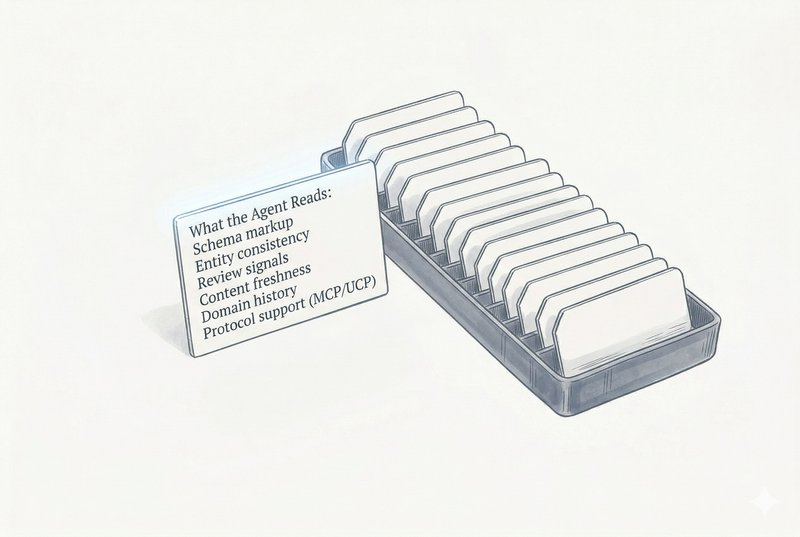
The SiteWarming perspective: The gap between "exists" and "gets cited" shouldn't depend on knowing what JSON-LD is. Every active domain gets structured identity, schema markup, entity declarations, machine-readable descriptions, because the systems deciding who gets heard can't read anything else. What is SiteWarming?
Content without structure is a conversation only humans can hear. And humans are no longer the first ones in the room.
The machine arrives first. It crawls. It parses. It decides whether your content is citable, verifiable, real. Not based on how well you wrote it. Based on whether what you wrote carries a machine-readable description of what it is.
The question isn't whether you've published enough. It's whether what you published can be read by the systems that decide who gets heard.
You wrote the content. You just forgot to introduce yourself to the machines reading it. And when agents start doing the shopping, the domain-as-resume becomes the domain-as-credential.
Image Credits
Photo by Maksym Kaharlytskyi on Unsplash
Share this article
Ready to Transform Your Domain Portfolio?
Start building real value with your domain investments today.