Why ChatGPT and AI Tools Can't See Parked Domains
 Bret Siers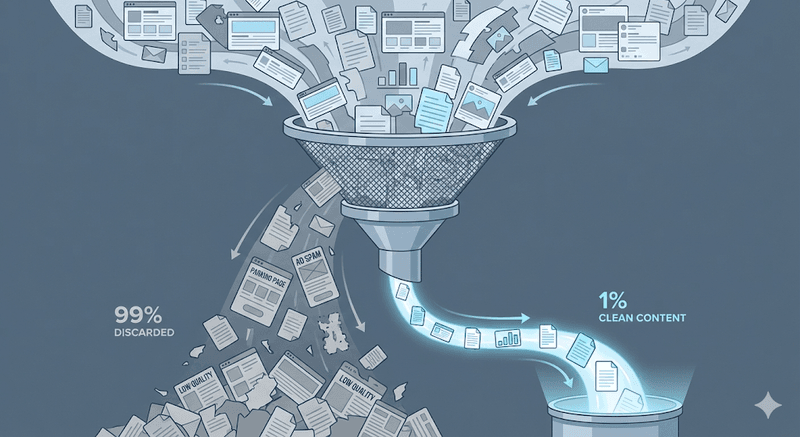
You registered the domain eighteen months ago.
You kept it parked while you figured out the business. Now you're finally ready to launch.
In that same eighteen months, the machine audience kept learning what exists on the web and what counts as signal. It built a rough map of your category from what it could read cleanly.
And your domain mostly wasn't part of the lesson.
Not because it was never visited. Because being visited is not the same as being included.
How models learn the web now
There's a persistent myth that models "browse" the internet in real time to answer questions.
Some products do fetch pages when a user asks. Some systems crawl on schedules. Some collect data that may later be used for training. These are different pipes. OpenAI documents multiple crawlers and user agents for different purposes.
But across all of them, the requirement is the same: the system needs certainty about what it's looking at.
Humans can infer intent from a "coming soon" page. Machines mostly can't. They parse what's there.
Filtering is the main event
Founders tend to picture "the web" flowing into systems as-is.
It doesn't.
The web gets strained. Hard.
A useful anchor comes from the GPT-3 paper's description of how they handled Common Crawl. They report 45TB of compressed plaintext before filtering, reduced to 570GB after filtering.
That is not a cleanup pass. It is a survival test.
Now apply that to a parked domain.
A parked domain is, by definition, thin. One academic description calls it "an undeveloped domain" with "no content other than automatically computed advertising banners and links."
Automatically computed. Advertising. Links. No unique content.
This isn't punishment. It's hygiene.
Training and retrieval pipelines want stable text that teaches them something. A parking template is duplicated at huge scale. It is low information density. It's monetized placeholder structure.
A parked page looks like the kind of thing filters are built to discard.
Parking pages signal differently than 404s
A 404 is a dead end.
A parking page is a commercially active dead end. It's noisy enough to be crawled, but too empty to be learned.
That's the quiet trap. You feel like you "did something" because the domain resolves. But the signal you shipped is not "this is coming." The signal is "this is a template that exists everywhere."
Parking pages and error states teach different lessons. I wrote more on that here: Parking Pages vs 404 vs Empty Sites.
Training windows close, and absence compounds
The compounding problem is time.
The web is collected in snapshots. Snapshots are filtered. Training runs happen. A model ships.
If your domain was parked through a long stretch of those snapshots, you didn't just "delay launch." You repeated a low-signal pattern often enough that it becomes the default machine impression of the domain.
Pattern recognition requires repeated signals. Systems learn what matters by seeing it again and again in extractable form.
Related: White Space Is Pattern Recognition.
We've lived the loop: buy the domain in clarity, then renew it while the idea stays dark. Warming is choosing to make an idea legible before you feel ready. Quietly. On purpose. It's not a launch. It's a small, truthful footprint that both human readers and machine readers can recognize as real presence. What is SiteWarming?
What to do with a parked domain
"Parked" is not neutral.
It is a public state, with a machine-readable meaning.
This isn't about chasing a new acronym or finding a trick. It's about whether your idea is legible in the signal layer that increasingly mediates discovery.
The question isn't: Will systems eventually find me?
The question is: What did I teach them while I was waiting?
If the answer is "ads and placeholders," you're starting from the wrong lesson.
Three moves that work without turning you into an engineer:
1) Replace the parking template with intent. One page is enough: what the domain represents, who it's for, and what it will become.
2) Use structure like you mean it. Clear headings, a visible publisher or author, a date, and a short section that states the purpose in plain language.
3) Hold the page still. Don't rotate through templates and "coming soon" gimmicks. Consistency is part of what makes something learnable.
This is what we mean by two audiences. Humans can give you the benefit of the doubt. Filters mostly can't.
Related: The Internet Now Has Two Audiences.
The parking page kept your domain registered.
It didn't keep it visible.
Share this article
Ready to Transform Your Domain Portfolio?
Start building real value with your domain investments today.