Domain Investing vs Domain Building: Which Strategy Wins?
 Bret Siers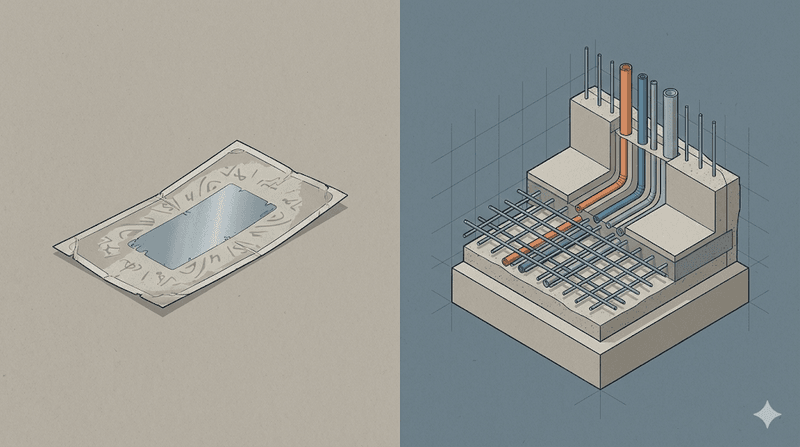
You wouldn't buy a commercial building lot, let the weeds grow six feet high, ignore the property taxes, and then expect a developer to offer you millions for it five years later.
Real estate doesn't work that way. Location matters, yes, but so do permits, utilities, maintenance, and basic legibility. Someone has to be able to look at the property and understand what it is, what it's for, and whether it's being cared for.
Yet this is how smart people treat digital real estate.
We buy a domain because we have a flash of clarity. We pay the registration fee. Then we wait. We treat the domain like a scratch-off ticket: cheap to acquire, easy to ignore, and somehow destined to pay off later.
But the web doesn't reward hope. It rewards what it can observe.
APNIC research cited by Hostinger finds that domain parking accounts for about 17.5% of registered domains. Nearly one in five names, sitting idle as a default state. Not building presence. Not accumulating trust. Just occupying space.
A domain isn't a lottery ticket. It's infrastructure.
And infrastructure decays when you don't maintain it.
What lottery-ticket thinking looks like
Lottery-ticket thinking is seductive because it's passive.
Buy the name. Park it. Or leave it as a blank page. Tell yourself you're "holding it for later."
That frame turns ownership into a single event, not an ongoing responsibility. It's the belief that the value is in the string of characters itself, and that time will do the rest.
But time doesn't do the work. You do.
The difference between owning a domain and stewarding one is the difference between buying land and maintaining property. One is a transaction. The other is a system.
Here's the quiet problem with "just holding it":
- You pay renewals every year.
- You carry the mental load of remembering why you bought it.
- The domain exists publicly, but communicates nothing.
When you treat a domain like a lottery ticket, you aren't building an asset. You're renting a row in a database.
That line is harsh, but it's clarifying. Because it points to the actual failure mode: we confuse registration with presence. We confuse ownership with legibility.
Small signals compound, but only if they exist. Parking doesn't compound. It just persists.
Parking pages aren't a pause state, they're a public state. If you want the mechanics behind that idea, here's the deeper cut: The Compound Effect of Small Signals.
What infrastructure thinking requires
If you swap the frame from "ticket" to "infrastructure," the behavior changes immediately.
Infrastructure is never set-and-forget. It has a lifecycle. It has maintenance windows. It has failure modes that stay invisible until they aren't.
DNS Made Easy says it plainly: domains require active oversight through their lifecycle, including registrations, DNS configurations, and security controls that need periodic review.
So what does infrastructure thinking look like for a founder with five domains, not five thousand?
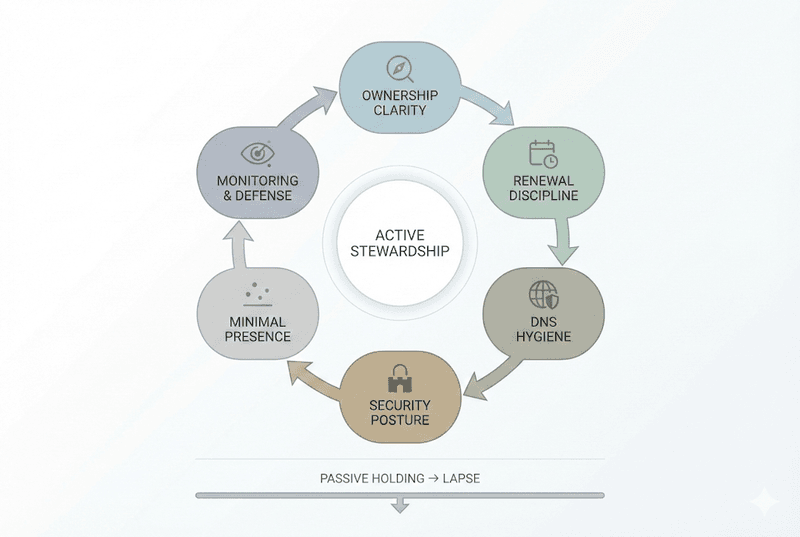
It looks like a lightweight stewardship loop you can actually run.
1) Ownership clarity
Is the domain registered under the company entity, or under a person's account? If someone leaves, do you still control the keys?
2) Renewal discipline
Auto-renew is a guardrail, not governance. Know what renews when, and where the payment method lives. Put dates somewhere that survives team changes.
3) DNS hygiene
Old records accumulate. Experiments become permanent by accident. Review DNS periodically, not because you love DNS, but because this is how your name resolves into reality.
4) Security posture
Lock the domain. Turn on multi-factor authentication. Reduce the number of accounts that can move it. If you'd protect your bank login, protect the asset that controls your email and identity.
5) Minimal presence
This is the part founders skip because it feels like marketing, but it isn't. Minimal presence is basic legibility. A simple page that says what this is, who it's for, and what's coming. A quiet footprint that proves the land is occupied.
It sounds like work because it is work.
And that's the point: the work is the value. Infrastructure thinking doesn't magically create outcomes. It makes your domain less fragile and more legible, which is the precondition for everything else you'll want to build on top of it.
Why scale forces infrastructure thinking
A common response is: "I only have a handful of domains. I don't need a system."
You might not need an enterprise program. You do need to respect the same physics.
A GoDaddy Corporate Domains survey cited by DNS Made Easy finds that 56% of large companies own more than 3,000 domains, and 29% manage more than 10,000.
Nobody manages ten thousand lottery tickets.
At that scale, domains become operational infrastructure by necessity: centralized administration, renewal processes, security controls, monitoring, ownership policies. Not because they're sophisticated, but because the alternative is chaos.
Here's the transfer lesson for Operators:
Scale isn't the point. Complexity is.
The moment you have multiple products, multiple experiments, multiple people with registrar access, or multiple domains tied to email and tooling, you've created enough complexity that "I'll remember" stops working.
Infrastructure has a pattern: it doesn't punish you daily. It punishes you on the day it fails.
Preparation isn't about selling. It's about keeping options open without panic. We pulled this thread harder in Preparing a Domain to Sell Without Trying to Sell It.
The real drivers of domain value
The biggest misconception in the domain world is that time equals value.
Time can help, but time alone doesn't create value appreciation. It just creates history. And history can be good, neutral, or harmful depending on what happened during it.
The premium end of domains tends to cluster around a few realities:
- a name that people naturally remember and type
- a category with real demand
- signals that suggest the name is usable and trusted
This is why the big sales get repeated like folklore. Insurance.com selling for $35.6 million is one of the most cited examples.
But the useful lesson isn't "go buy a better ticket."
The useful lesson is that the market tends to pay for names that reduce friction. Names that carry meaning. Names that fit intent. Often, names that already have observable demand and history attached to them.
A parked domain rarely earns that by accident.
Value comes from signals accumulated over time, not time alone. A domain becomes more valuable when it becomes more legible. When it has an identity. When it shows signs of stewardship rather than long-term vacancy.
And infrastructure management is not just "build content." It's also protective. DNS Made Easy describes defensive registrations, monitoring for abuse, and clear ownership policies as part of robust domain management.
We've lived the loop: buy the domain in clarity, then renew it while the idea stays dark. Warming is choosing to make an idea legible before you feel ready. Quietly. On purpose. It's not hype. It's a small, honest footprint that gives discovery systems something to repeatedly observe. What is SiteWarming?
What happens when infrastructure lapses
This is where the "domains are cheap" mindset breaks.
If you lose a scratch-off ticket, you lose what you paid for it.
If you let domain infrastructure lapse, you can lose control of the name and everything attached to it.
DNS Made Easy describes the risks in three buckets that every Operator recognizes:
- Loss of control: if a domain expires, another party can register it, leading to confusion or misuse.
- Service disruption: expired or misconfigured domains can break email, web access, APIs, and other critical services.
- Reputation damage: a malicious actor controlling a former domain can redirect visitors, harvest credentials, or distribute malware.
This is the infrastructure difference:
You can let a lottery ticket expire with no consequence. You can't let infrastructure lapse without creating an opening.
The fix isn't paranoia. It's stewardship.
Defensive registrations where it matters. Monitoring for lookalikes if the brand warrants it. Centralized ownership. Fewer admins. Clear renewal discipline. A minimal footprint so the domain is not just owned, but inhabited.
Ownership is a legal state. Stewardship is an operational state. Related: From Ownership to Stewardship (same pattern, different angle).
The choice
Your domain isn't a ticket you bought and shoved in a drawer.
It's land you own.
Land appreciates through development and maintenance. Land decays through neglect. And land that looks abandoned invites the wrong kind of attention.
So the question isn't whether you're a "domain person."
The question is simpler:
Which approach are your domains experiencing right now?
Infrastructure, or lottery-ticket thinking.
Share this article
Ready to Transform Your Domain Portfolio?
Start building real value with your domain investments today.