How to Manage a Domain Portfolio Without Building Every Site
 Bret Siers
There's a question owners ask: "What can this domain do for me?"
And there's a different question stewards ask: "What am I responsible for here?"
Same domain. Same person. Completely different relationship with the asset.
The answer to that question predicts almost everything that happens next. It predicts whether a domain accumulates value or collects dust. It predicts whether it survives a transition or expires quietly.
We can call it "portfolio management" or "asset allocation," but those are clinical labels for a very human posture. What matters is whether you relate to what you hold as a possession, or as something entrusted to you.
That shift isn't semantic. It's operational.
The difference one word makes
Ownership feels like the highest form of control. "It's mine." It's clean, legal, and quietly extractive in the way it frames the relationship: I can use it, sell it, or ignore it.
Stewardship is different.
A wealth-management definition gets the distinction right: ownership says, "This is mine to use as I wish." Stewardship asks, "What has been entrusted to me, and how do I care for it wisely?" It's not about losing control. It's about changing your relationship with control.
When you view a domain as something you own, you tend to wait for it to pay you back.
The renewal fee feels like a tax. The silence feels like the asset failing you. The default parking page feels neutral, because you haven't decided yet.
When you view a domain as something you steward, you're caring for a piece of digital territory.
Renewals become an investment in tenure. Silence becomes a responsibility. If the signals aren't there yet, you build them. If the idea isn't legible yet, you make it legible.
Parking is the purest expression of ownership posture. "I have it. I'm not doing anything with it. Maybe later."
But domains are infrastructure. Infrastructure doesn't reward possession. It rewards maintenance.
A parked domain is not a pause state. It's a public state. It's a signal the internet can read.
Infrastructure doesn't improve by being held. It improves by being maintained. I wrote more on this here: Domains Are Infrastructure, Not Lottery Tickets.
Why stewards build and owners wait
The posture dictates the behavior.
If you're an owner, maintenance feels like overhead. You minimize it. You leave the default page up because changing it takes effort, and you "haven't decided yet." You wait for external validation to justify the work, an offer, an inbound, a reason.
If you're a steward, maintenance is the work. You build signals because stewards create value, they don't just preserve the option of value.
This isn't unique to domains. You can see the same dynamic in software teams.
Nicole Tietz argues that "code ownership" can lead to defensiveness and control-seeking, while stewardship shifts attention toward how well the code serves the group. Owners worry about the value of what they own. Stewards worry about how well it can serve.
That's the mechanism.
The owner defends the asset's current state.
The steward prepares the asset for its future state.
You can feel this difference in small decisions:
- The owner thinks, "I'll update it when I know what I'm building."
- The steward thinks, "I'll update it so the world can understand what I'm building, even before it's finished."
Stewardship doesn't demand a full product. It demands a clear footprint. It demands intent.
A warm page. A simple statement. A coherent structure that reduces ambiguity. Enough context that a human, or a machine, can tell this is cared for.
That's why exit readiness tends to come from preparation, not pursuit. If you keep something legible, you can hand it off without a scramble.
Optionality is earned through care, not through hoping for a perfect buyer. We pulled this thread harder in Preparing a Domain to Sell Without Trying to Sell It.
The survival evidence
Stewardship can sound like philosophy until you look at what it does over long horizons, in places where governance turns into outcomes.
Research summarized by De Roos reports that steward-owned companies are six times more likely to survive beyond four decades compared to traditional businesses.
A Danish study discussed in a Purpose Foundation white paper puts sharper numbers on the same pattern: conventionally investor-owned companies show a 10% survival probability after 40 years, while foundation-owned companies show 60%.
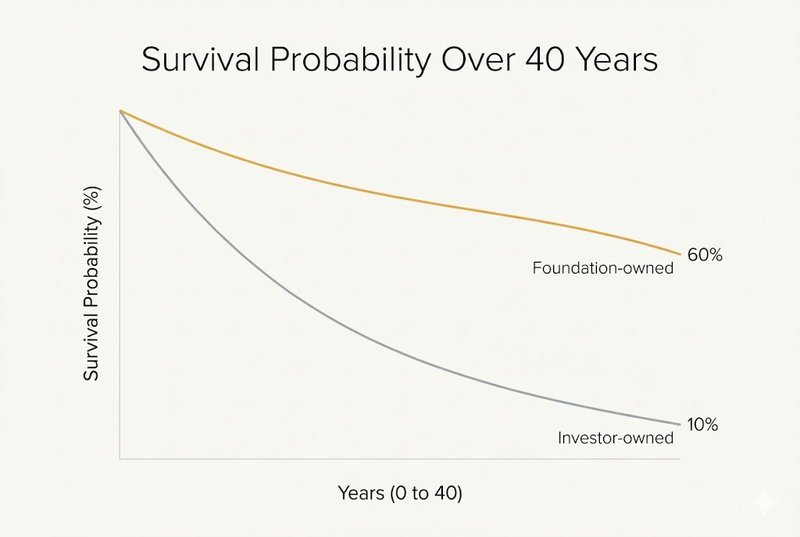
That gap is time preference made visible. It's what happens when responsibility beats extraction over long horizons.
Intellectual honesty matters here.
Those numbers describe companies, not domains. A domain is not a legal entity. It doesn't have employees, governance boards, or supply chains.
So the transfer here is interpretation. But it's a grounded one.
The pattern is that stewardship structures and stewardship behaviors create durability, especially when the asset's value depends on continuity, trust, and long time horizons.
Domains are long-horizon assets by nature. You don't buy a name for what it is today. You buy it for the future it could anchor.
So when you treat a long-horizon asset like a lottery ticket, you choose a short-horizon posture for a long-horizon thing. That mismatch is where decay begins.
Not dramatic decay. Quiet decay.
The slow drift into invisibility, where nothing is updated, nothing is clarified, and the internet learns the most durable lesson of all: "No one is here."
The succession problem ownership creates
Ownership has a hidden failure mode. It struggles to imagine a world after the owner.
That's why succession collapses assets even when value exists.
The World Economic Forum describes a "silver transition" where many privately owned businesses are owned by people approaching retirement, and when succession plans fail, the result often becomes closure or takeover.
Business Initiative reports a generational survival arc that shows how hard transfer really is: 30% make it to the second generation, 12% to the third, and 3% to the fourth or beyond.
Those are business statistics. The domain parallel is still painfully obvious.
Domains are frequently held as personal memory. One person knows why they bought it. One person knows where the logins are. One person knows the intent.
That means the asset doesn't really exist as an asset. It exists as a private thought.
And private thoughts don't transfer well.
Here's the gut-check:
If you hold 50 domains and you're the only one who knows what they're for, why you bought them, or how to access them, you haven't built a portfolio.
You've built a liability.
Not because 50 is a bad number. Because un-stewarded assets accumulate obligations. They accumulate confusion. They accumulate renewal decisions made under time pressure.
Stewardship naturally includes succession because it begins with an admission: you are a temporary guardian.
Once you accept that, you start making the asset legible to whoever comes next, even if "whoever" is just future you, six months from now, returning to the idea with fresh eyes.
We've lived the loop: buy the domain in clarity, then renew it while the idea stays dark. Warming is choosing to make an idea legible before you feel ready. Quietly. On purpose. It's not hype and it's not a launch. It's a small, honest footprint that keeps the internet from learning the wrong thing about what you're building. What is SiteWarming?
What stewardship looks like for domains
If you want to move from owner to steward, here are the rules. Not rules like a checklist. Rules like a posture.
1) Stewards develop, owners park.
Every domain you hold is either being cared for or decaying. There is no neutral state on the internet. Stewardship means a warm signal: a simple page, a context, a reason for being. Not a 404. Not a blank placeholder. Not a "maybe later" page.
This rule is about state. Alive, or abandoned. Cared for, or decaying.
2) Stewards build signals, owners wait for luck.
Value doesn't accumulate through hope. It accumulates through presence.
The internet has two audiences now, humans and machines, and both rely on legible signals to decide what's discoverable and what's ignored. This rule is about audience. Your work has to be readable by more than one kind of reader.
Discovery systems learn from repeated observation, and empty space becomes a durable signal. This shows up in a different form in The Internet Now Has Two Audiences.
3) Stewards prepare for succession, owners create dead ends.
A steward documents the "why." They attach the handles. They make access and intent easy to transfer. If they had to hand it over tomorrow, the next person could understand the asset without a meeting.
This isn't morbid. It's practical. Succession is often just continuity under stress: a busy season, a cofounder change, a new project priority, a life event.
Stewardship builds for those moments.
4) Stewards measure responsibility, owners measure possession.
The metric isn't "how many domains do I own?" It's "how many am I actively caring for?"
This is where scale forces honesty. Managing 10 domains can be intuition. Managing 50 requires systems, because responsibility doesn't scale through memory.
Capacity, not ambition, becomes the constraint at scale. Related: Managing 10 Domains Is Easy. Managing 50 Changes How You Think.
5) Stewards think in decades, owners think in transactions.
The survival gap in stewardship research isn't luck. It's what long-term care looks like when you graph it.
Domains don't need your urgency. They need your continuity.
Not because continuity is romantic, but because the internet rewards what stays coherent. A name with a living, maintained footprint becomes easier to trust, easier to understand, and easier to hand to the next builder.
That's how domains compound. Not as lottery tickets. As cared-for territory.
Ownership is control without responsibility. Stewardship is control with a duty.
You can hold a domain and wait for it to matter.
Or you can care for it and watch it become something.
The domain doesn't know the difference. But you do. And increasingly, the systems that shape discovery can tell what's cared for and what's abandoned.
Ownership asks: "What's in it for me?"
Stewardship asks: "What have I been given responsibility for?"
The answer changes everything.
Share this article
Ready to Transform Your Domain Portfolio?
Start building real value with your domain investments today.