Long-Tail Audiences as Revenue Infrastructure
 Bret Siers
AG1 spends something like $2.2 million a month on podcast ads. They can buy a slot on basically any show that exists — fitness, biohacking, health and wellness, whatever they want.
Their highest-converting audience was bird watchers.
Not fitness enthusiasts. Not biohackers. Not the health-conscious mainstream that looks like the obvious customer. Their Senior Partnerships Manager talked about it publicly — niche communities, including bird-watching podcasts, converted at rates the mainstream shows couldn't come close to. 63% of listeners don't skip ads on niche podcasts, according to Acast and Edison Research. The audience was smaller. The attention was deeper. And deeper attention converts in ways that raw scale just doesn't.
A supplement company spending millions per month discovered that the audience nobody fought over was the one that actually paid.
This isn't about podcast ads. This is about how markets actually work. The audiences nobody fights over are where trust lives. And trust is where revenue starts.
The Audience That Actually Pays
Chris Anderson's Long Tail work showed demand exists in every niche — we've already talked about why patience is the mechanism that unlocks it. The audience exists. That's settled. The question is what happens when you're the only one who shows up for it.
Amazon proved the commercial version. Back when Anderson first published the research, inventory beyond the top 130,000 book titles accounted for more than a third of Amazon's sales — the stuff no physical store would ever stock. A follow-up study by Brynjolfsson, Hu, and Smith found that share was still growing years later. The long tail doesn't shrink. It compounds.
In the third-tier markets we've already explored — the spaces too small for venture capital, too niche for media companies — a warm domain doesn't compete for attention. It inherits it. The audience is unclaimed not because it's worthless, but because nobody recognized the white space.
That's not a consolation prize. That's unclaimed infrastructure.
Why Small Audiences Pay More
Here's the thing — this isn't abstract. You can actually measure it. Three things happen in small audiences that don't happen in big ones. And they explain why small keeps winning.
1. Trust density. In a small community, the publisher has a direct relationship with a higher percentage of the audience. Trust isn't distributed across millions. It's concentrated. StackInfluence ran the numbers. Nano-influencers — under 10,000 followers — converted at roughly 7% of engagements. Macro-influencers? Three percent. More than double the conversion rate from the smaller audience. And 56% of marketers report better results with nano-influencers, because consumers trust smaller creators more.
500 people who deeply care will outperform 50,000 who vaguely notice. Every time.

2. Competition absence. Nobody else is serving this audience. There's no alternative voice. The warm domain isn't competing for position — it occupies the position. And competition absence means the customer acquisition cost for organic discovery drops to nearly zero. People find you because you're the only one there.
3. Coherence premium. A small audience that self-selects around a specific interest has dramatically higher intent than a broad audience with vague overlap. Someone who subscribes to a newsletter about vintage mechanical pencils cares about mechanical pencils in a way that a general stationery audience never will. Intent converts. Vague interest doesn't.
The economics show up directly in newsletter sponsorship pricing. Niche B2B newsletters command CPMs of $50 to $100 or more. Broader consumer newsletters sit closer to $15 to $35. And newsletters focused on specific content have 16% higher open rates and 21% higher click-through rates than generic ones.
The math, for anyone who wants to run it: 500 subscribers at a $75 CPM with consistent engagement produces real money. Not life-changing at first — but repeatable. Meanwhile, 50,000 subscribers at $20 CPM with 1.5% click-through produces a higher total number — but lower per-subscriber value, higher churn, and a constant need to replace the people leaving. The 500-subscriber publisher can also sell premium products — courses, consulting, tools — at prices the big publisher can't, because trust enables premium pricing.
That's what the economics actually look like. Not a consolation prize. An edge nobody else has.
And here's what happens when you wait and do it right. If you monetize before trust has formed, you kill the thing that was going to pay you. That's premature extraction, and it's how most people blow it.
Revenue Infrastructure, Not Revenue Events
There's a difference between building something that keeps paying and chasing the next launch. Most people can't tell which one they're doing.
A product launch generates a spike. A subscription generates a baseline. One requires a new audience for each event. The other serves the same audience repeatedly. One extracts value and moves on. The other accumulates value and compounds.
Kevin Kelly called this in 2008. A creator needs only 1,000 true fans to make a living. If each true fan spends $100 per year, that's $100,000 annually. The math was elegant. And almost twenty years later, it keeps being right.
Teachable creators prove it at micro scale. The platform regularly highlights instructors making six figures from cohorts of under 100 students. That's not a massive audience — that's a small group of people who trust the person teaching them enough to pay premium prices. Not launch events. Not product drops. Revenue infrastructure — the kind that compounds instead of requiring you to start over every time.
| Revenue Events | Revenue Infrastructure | |
|---|---|---|
| Pattern | Product launch generates spike | Subscription generates baseline |
| Audience need | Requires new audience for each event | Serves existing audience repeatedly |
| Value model | Extraction: take value, move on | Accumulation: add value, compound |
| Depends on | Reach | Trust |
| Scales with | Marketing spend | Time |
A warm domain in a niche market builds three layers of revenue infrastructure over time:
Attention infrastructure. The audience knows where to find you. You don't pay to reach them. They come back.
Trust infrastructure. The audience believes what you publish. Recommendations convert. Sponsorships perform. Products sell at premium prices.
Distribution infrastructure. The audience shares your work within the niche. Word-of-mouth in a small community is proportionally more powerful than in a large one because density is higher. When everyone knows everyone, a recommendation travels fast.
Revenue events require you to find new people. Revenue infrastructure means the people are already there. The difference isn't scale. It's whether your audience is a crowd or a community.
The Compounding Loop
Content produces trust. Trust produces audience. Audience produces revenue. Revenue produces more content. The loop repeats. Each time it gets a little stronger.
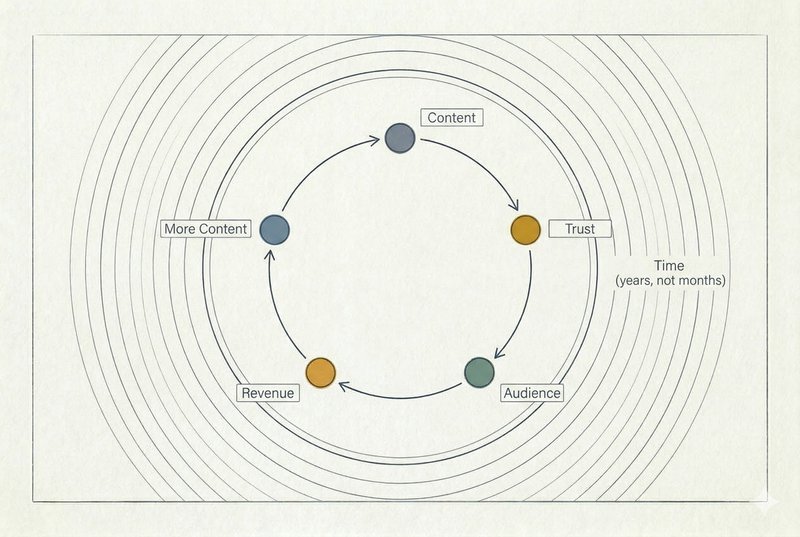
But the loop has requirements. And most of them are about time.
Trust requires consistency. You can't build trust with one article. You build it with fifty articles over two years in the same niche. That means showing up when nobody's watching. Publishing when the metrics show nothing. Just being willing to stay — that's the advantage most people can't replicate.
Compounding requires survival. The loop doesn't produce visible returns in month three or month six. The curve inflects at year two or three, not month two or three. Most people quit before the loop starts paying. The ones who don't become the default voice in their niche.
Small scale enables coherence. A domain trying to serve everyone can't build trust with anyone. A domain serving 500 people in one niche builds trust with all of them. Coherence is the prerequisite for the loop to function.
Competition absence sustains the loop. In a third-tier market, nobody else is running this loop. The warm domain isn't competing for attention inside the loop — it's the only loop running.
Ben Thompson started Stratechery in 2014. By 2020 he was making over $3 million a year. By 2023, estimated revenue exceeded $5 million — roughly 40,000 paid subscribers at $12 per month. A niche technology analysis publication that no mainstream publisher would have greenlit. The loop didn't spike. It compounded. The audience grew because the content grew because the trust grew because the audience grew.
The patience premium works here the same way it works everywhere else in stewardship. The loop doesn't care about speed. It cares about continuity.
Building for the Long Tail
The gap isn't understanding. It's execution — sitting with a small number and not interpreting it as failure.
Here's what it looks like in practice.
1. Choose the depth, not the breadth. The topic is already determined by the domain's subject — its reason for existing. The decision is how deep to go. The long-tail audience nobody else bothers with is where the warm domain has structural advantage. Not because it's easy. Because it's unclaimed.
2. Publish for the audience that exists, not the audience you wish existed. In a third-tier market, fifty people reading your content isn't failure. It's the beginning of the compounding loop. Those fifty people, served consistently, become the trust infrastructure.
3. Measure trust, not reach. The wrong metric is "how many people saw this." The right metric is "how many people came back." Return visitors. Subscribers. Replies. These are trust signals. They predict revenue infrastructure. Reach predicts nothing.
4. Expect the gap. There's a period — often twelve to twenty-four months — where the content exists, the trust is forming, but the revenue hasn't arrived. This isn't failure. This is the pre-infrastructure phase. Every warm domain in a niche market passes through this gap. The ones that survive it become the default.

5. Let the audience define the product. In a small, coherent niche, the audience will tell you what they need. Sponsorships, courses, consulting, tools, premium content — the revenue model emerges from the relationship. Revenue infrastructure isn't planned from a spreadsheet. It's cultivated from the conversation.
"Too small" is a judgment based on venture-capital math. Venture capital needs massive markets because it needs massive returns on a short timeline. That's their math, not yours. A warm domain operates on the stewardship timeline — where small audiences, served consistently, become the most valuable asset the domain owns.
The smallest market you can find isn't a limitation. It's the foundation. It's the tier where trust forms fastest, competition is absent, and the compounding loop runs uncontested.
This is what continuous care actually produces. Not a set-and-forget outcome. A compounding one. The next decade will make this even clearer — that's where we're headed next. And the market where your long-tail audience lives? You don't stumble into it. You recognize the patterns.
SiteWarming exists because the audience nobody fights over is usually the one worth serving. A warm domain in a long-tail market builds the trust infrastructure that makes revenue possible — not by chasing scale, but by being the only voice that stayed. What is SiteWarming?
Revenue infrastructure isn't built by reaching more people. It's built by staying with the same people longer than anyone else will.
The audience nobody else wanted — the bird watchers, the 61-student cohort, the 500-subscriber newsletter in a market that barely shows up in any analyst's report — those are the audiences that actually pay. Not because they're large. Because they're yours.
You don't need to get big. You need to stay.
Share this article
Ready to Transform Your Domain Portfolio?
Start building real value with your domain investments today.